"In a democracy like ours, it is essential to value a difference of opinion and its existence. Nobody has a right to attack anybody or indulge in hooliganism just because someone carries a different opinion. The Constitution of India has provided every citizen the right and freedom of speech and expression " NO IF or BUTS.
SS Gestapo
The Schutzstaffel (SS; also stylized as ᛋᛋ with Armanen runes; German pronunciation: [ˈʃʊtsˌʃtafl̩] ( listen); literally "Protection Squadron") was a major paramilitary organization under Adolf Hitler and the Nazi Party (NSDAP) in Nazi Germany, and later throughout German-occupied Europe during World War II.
listen); literally "Protection Squadron") was a major paramilitary organization under Adolf Hitler and the Nazi Party (NSDAP) in Nazi Germany, and later throughout German-occupied Europe during World War II.
Do you see any similarities?
Is Shiv Sena a party of hooligans and goons? Why would Marathis vote for such a political party that is spreading Gunda Raj in India?
Yes. A big YES!
"On December 19, I posted that Chief Minister Uddhav Thackeray's comparison
of Jamia Millia incident with Jallianwala Bagh was wrong. After that 25-30
people thrashed me and tonsured my head," Hiramai Tiwari told ANI. (Photo: ANI)
Mumbai: A resident of Wadala was allegedly thrashed by Shiv Sena workers on Sunday for posting "objectionable" social media post against Chief Minister Uddhav Thackeray.
"On December 19, I posted that Chief Minister Uddhav Thackeray's comparison of Jamia Millia incident with Jallianwala Bagh was wrong. After that 25-30 people thrashed me and tonsured my head," Hiramai Tiwari told AN
On December 17, Thackeray had compared police action in Delhi's Jamia Millia Islamia to Jallianwala Bagh massacre.
"What happened at Jamia Millia Islamia University is like Jallianwala Bagh. Students are like a 'Yuva bomb'. So we request the Central government to not do what they are doing with students," he had said

Mangesh Kadu, lives in Cottbus, Brandenburg, Germany (2018-present)
Updated Apr 12 2017 · Author has 437 answers and 1.1m answer views
Originally Answered: Is Shiv Sena a party of hooligans and goons? Why did the Marathis vote for such a political party which is spreading Gunda Raj in India?
Yes. A big YES! And this comes from a marathi manoos, living in Mumbai Metropolitan region, considered to be a stronghold of the party.
The recent display of hooliganism by their MP, Ravindra Gaikwad is a proof enough of this. Not only did he hit an Airline staff with a footwear 25 times, that shameless man bragged about it on TV. Air India and 6 other airlines had banned him on their travel list and cancelled his tickets 4 times. Poor he had to travel by train, vehicle and Chartered plane. Man I enjoyed all this time. Sadly, the ban is lifted, which was surely to happen, though I expected some more ticket cancellations.
What he did was definitely wrong, and it was so unbecoming of a public representative to do this. However, as always, Shiv Sena leadership and the average ‘shivsainik’ stood behind this stupid man and trended hashtags like #ISupportRavindraGaikwad. One of my friends who is a Shivsena Member, said shamelessly “MP shi waad ghalnar tyala chappalach milnar” (The one who argues with an MP deserves to be hit by a chappal). So folks, I present to you their true mentality -You elect their representatives, only so that these despicable creatures can behave as pathetically as possible, and if you argue with them, you deserve a chappal in your face!
This is not all. Their (only) Union minister, Anant Geete, yesterday charged at the Union Civil Aviation Minister Ashok Gajapati Raju Pusapathi, during a discussion in the LS and is unapologetic, which is completely Shivsena behaviour. A Cabinet minister of their party behaves in such a junglee manner, what do you expect from a grassroot worker? Anything less than hooliganism?
Back in 2012, when Balasaheb Thackeray expired, a day after Bhaubij, a diwali day, we, along with almost everyone in the locality, voluntarily did not switch on our diwali lanterns as a mark of respect. This happened all over the city. Today I wonder, seriously do these people even deserve our respect?
Their current leader is one of the most loud mouthed person I have ever seen. He just bad mouths their new found rival and resorts to personal attacks on the PM and his father. He called him Afzalkhan before Maharashtra LA elections. The same person because of whose alliance, they have 18 LS MPs, when in reality they would not have got even 8, had they contested alone.
Our Municipal Council is governed by Shiv Sena. And it is an epitome of corruption. The city is in distress, with visible lack of infrastructure. In monsoons, the roads turn into waterways and we joke about buying boats instead of bikes. The construction of an important arterial road is underway from 2014 September and it has still not been completed. The paver blocks used for the work are already crushed to powder, such is their quality. Side gutter are non existent, rainwater runs on roads. They recently broke a newly laid concrete road, because they forgot to lay the drainage lines. There are no parks, (with a couple of exceptions) but parks are a luxury, when a necessity like roads is not being provided. We are in the MMR and we still face erratic electric supply. Law and order is down the drains. Loud music blares late night. People dig up holes in the roads so they can put up bamboos for a pandal during a marriage in the house. Hawkers and Rikshawallahs are the worst, with no control by the authorities. 6 Corporators have been murdered in past 10 years. All these problems, in a city in Mumbai Metropolitan region, where the MP, MLA as well as the local administration is of Shiv Sena. Whereas another Municipal council in MMR, 8 km further that means away from Mumbai than us, has a good administration and good infrastructure. We have a joke on social media about our city.

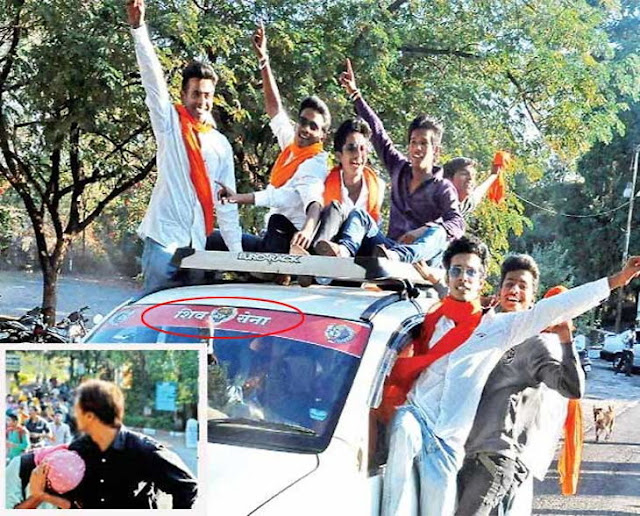
Nagpur: Scores of young couples had to face the wrath of Shiv Sena activists who have launched a drive against Valentine's Day celebration.




Shiv Sena threatens to stop flights from Mumbai, Twitter takes ‘Grounded Gaikwad’ to task
https://www.youtube.com/watch?v=jSQOBe9yw5UNagpur: Scores of young couples had to face the wrath of Shiv Sena activists who have launched a drive against Valentine's Day celebration.


Not just Ravindra Gaikwad, today even Anant Geete proved that Shiv Sena is masquerading hooliganism with politics
Being unapologetic over the deeds of his party MP, Anant Geete gave an open threat that now no flight will take off from Mumbai.

In an unprecedented move in parliament today, Shiv Sena lawmaker Anant Geete went charging at Civil Aviation Minister Ashok Gajapathi Raju, who had refused to intervene on the flying ban on MP Ravindra Gaikwad for assaulting a staff of Air India.
The two nearly came to blows before Smriti Irani and Union Home Minister Rajnath Singh intervened and caught hold of Anant Geete, the lone Shiv Sena minister in the Union Cabinet, before he reached Raju.
SS Ahluwalia, the MoS for Parliamentary Affairs, also had to intervene and push Shiv Sena lawmakers aside to rescue Raju. Opposition MPs stood up to bring the incident to the Speaker’s attention, leading to an adjournment.
The row rapidly escalated just moments after Ravindra Gaikwad presented his version of the Air India incident in parliament and said he had only shoved the employee when he insulted MPs.
The incident has once again ignited a debate on whether it is a political party or an extremist organisation. The kind of ‘goondagardi’ which Sena leaders display on several occasion clearly highlights that Shiv Sena is masquerading hooliganism with politics.
The unruly behaviour by its leaders proves that the Sena doesn’t care about anyone and they will keep indulging in hooliganism and ‘mob justice’.
Being unapologetic over the deeds of his party MP, Anant Geete gave an open threat that now no flight will take off from Mumbai. Such kinds of statements from a Union Minister aren’t expected, however, if we talk about Shiv Sena, then ‘Thokshahi’ (violence), as the Sena proudly calls it, has become the hallmark of the party and of its offshoots.
Apologise? But why?
As almost everyone spluttered in rage at the Shiv Sena’s blatant defence of their behaviour – senior party leader Sanjay Raut also came in support of Gaikwad and reportedly said that his side of the story is being suppressed.
This is the classic Sena behaviour. Vandalism and bullying are what its leaders believe in and preach it to the party members. It seems that the word sorry isn’t in their dictionary, instead, they’ll create more ruckus when it comes to an apology.
The Sena has alleged a breach of the MP’s privilege, as he has been barred not just by the national carrier but even private airlines.