“Let thy food be thy medicine and thy medicine be thy food.” This advice is as true today as it was more than 2,000 years ago when Hippocrates, the famous Greek physician, coined the phrase. But exactly what foods should you be eating to keep the doctor away? The answer is more complex than you might think. How each food affects you depends on how much of it you eat, when you eat it, and what you eat it with. In addition, how the food is grown, stored, and cooked can make a big difference, as can medications you’re taking.
Friday, March 09, 2018


Thursday, March 08, 2018
Learning is no longer scheduled for or measured by “Butt in the seat time"
In 1979 when I entered
the Osmania Medical College as a greenhorn medical student, I found the
teaching to be no different than what I was taught by my teachers in high school.
The only difference
was instead of thin light text books there were massive tomes which used to
give good exercise to our arms and backs. The same old time tested “Practicals”
which had absolutely no relevance to the actual practice of medicine were
conducted by the tutors of the preclinical subjects.I still cannot fathom, why I
had to find out the side and muscle attachments of a scaphoid bone or the humerus,
thrown like dice on the table by the Anatomy “external” even today.
Main emphasis was on studying
retaining facts and regurgitating them without any modification on the asking
of the examiner. There was no logic or rationale to anything which was taught. After
coming to clinicals, at least few of my teachers taught me some rudiments of,
what real doctoring is like. People knew
all about esoteric syndrome found only in the Ashkenazim Jews but had no clue to treat a child with fever
or relieve an old man’s urinary obstruction. In fact at the end of the
final year if I was faced with
someone having a medical emergency probably I would have either fainted then
and there or ran away.
People who
were savvy with the way
world works and had
natural inborn people’s
skills were no where in the top of the
graduating class. But 20 years later
quite a few of the toppers
were real failures or remained
mediocre where as theses guys
with the soft skills
rose to the top.
With the advent
of the digital revolution, Internet
and ready use of Google by many patients,
we in the medical world are
facing a different world now. Which is going to become even more complex
and challenging in the future .
There is an
urgent need for a paradigm shift in teaching of Medicine
1. Learning is no longer
scheduled for or measured by “Butt in the seat time"
2. Educators need to be mindful of evaluating
students on learning outcomes and assessing the impact of e-learning.
3. Understanding and learning
the essentials of E-Learning is necessary for both new and experienced
educators. They must learn how to use e-leaning tools to facilitate learning
and integrate them into courses and programs.
4. To meet the needs of
these learners, educational institutions have to make significant investments
in learning infrastructure such as classrooms equipped with videoconferencing
and learner response systems, simulation centers with high-fidelity human
patient simulators, as well as ubiquitous wireless access and online learning
course management systems.
5. As increasing numbers
of the “net-generation” enter Medical schools and the Health workforce, faculty
and staff educators are challenged to provide educational experiences for
learners who are savvy users of e-learning technologies.
6. E-learning requires
systems level planning for acquiring resources such as hardware and software,
identifying stakeholders, developing the support team, and orienting learners
and educators.
7. today’s medical
educators are likely to find themselves teaching in these “high-tech”
classrooms and having clinical experiences in agencies where using e-learning
is the norm, not all are prepared to do so.
8. Define e-learning,
explain the theoretical underpinnings of learning with technology a design
process to create an optimal learning environment. (39)
9. Learners may retrieve
reading materials from electronic book readers and access information from
smartphones, and often choose to enroll in online educational programs because
they are accessible and convenient.
10. Strategic planning
will be required for all administrators and e-learning coordinators charged
with leading the planning, implementing, and evaluating of the e-learning
enterprise.
11. Learners relate to
educators and each other through social networking Web sites and text
messaging.
12. How to teach in
Web-supported courses, use technology in the curriculum, and develop and manage
clinical simulations.
13.
Concepts
of continuous quality improvement are to
be threaded throughout the learning
experience
Sunday, March 04, 2018
What is a DRG diagnostic related grouping
A DRG, or diagnostic related grouping, is how Medicare and some health insurance companies categorize hospitalization costs and determine how much to pay for a patient's hospital stay. Rather than paying the hospital for what it spent caring for a hospitalized patient, Medicare pays the hospital a fixed amount based on the patient’s DRG or diagnosis.
If the hospital treats the patient while spending less than the DRG payment, it makes a profit.
If the hospital spends more than the DRG payment treating the patient, it loses money.
Background
Years ago, when you stayed in the hospital, the hospital would send a bill to Medicare or your insurance company that included charges for every Band-Aid, X-ray, alcohol swab, bedpan, and aspirin, as well as a room charge for each day you were in the hospital. This encouraged hospitals to keep you hospitalized for as long as possible and to do as much to you as possible while you were in the hospital. After all, the longer you were in the hospital, the more money the hospital made on room charges. The more procedures you had done while hospitalized, the more Band-Aids, X-rays, and alcohol swabs you used.
As health care costs went up, the government sought a way to control costs while encouraging hospitals to provide care more efficiently. What resulted was the DRG.
Starting in the 1980s, DRGs changed how Medicare pays hospitals.
Instead of paying for each day you’re in the hospital and each Band-Aid you use, Medicare pays a single amount for your hospitalization based on your DRG, which is based on your diagnosis (including secondary diagnosis, if applicable), any surgical procedures involved, and your age and gender.
The idea is that each DRG encompasses patients who have clinically similar diagnoses, and whose care requires a similar amount of resources to treat.
Developing this system was no easy feat, as explained by the Centers for Medicare and Medicaid Services.
The DRG system is intended to essentially equalize hospital profit margins, regardless of where a hospital is or what type of patients it treats. But inefficiencies still exist in the system, leading some hospitals to focus resources on services that end up with higher profit margins, despite the use of DGRs.
The Affordable Care Act ushered in some new payment reforms for Medicare, including bundled payments and Accountable Care Organizations (ACOs). But DGRs still form the basis of the Medicare hospital payment system.
How DRG Payment Amounts Are Calculated
Medicare starts by calculating the average cost of the resources necessary to treat Medicare patients in a particular DRG. That base rate is then adjusted based on a variety of factors, including the wage index for a given area (a hospital in NYC pays higher wages than a hospital in rural Kansas, for example, and that's reflected in the payment rate that each hospital gets for the same DRG).
For hospitals in Alaska and Hawaii, even the nonlabor portion of the DRG base payment amount is adjusted by a cost of living factor.
There are also adjustments to the DRG base payment if the hospital treats a large number of uninsured patients, or if it's a teaching hospital.
How a DRG Works
A simplified version goes like this: Mr. Koff and Mr. Flemm were both admitted to the same hospital for treatment of pneumonia. Mr. Koff was treated and released in two days. Mr. Flemm’s hospitalization lasted 10 days.
Since Mr. Koff and Mr. Flemm have the same diagnosis, they have the same DRG. Based on that DRG, Medicare pays the hospital the same amount for Mr. Koff as it does for Mr. Flemm even though the hospital spent more money providing 10 days of care to Mr. Flemm than providing two days of care to Mr. Koff.
With a DRG, Medicare pays for a hospitalization based on the diagnosis the patient was hospitalized to treat, not based on how much the hospital did to treat the patient, how long the patient was hospitalized, or how much the hospital spent caring for the patient.
In the case of Mr. Koff, the hospital may have made a small profit. The DRG-based payment was probably a little bit larger than the actual cost of Mr. Koff's two-day stay.
In the case of Mr. Flemm, the hospital probably lost money. It surely cost the hospital more to care for Mr. Flemm for 10 days than the DRG-based payment it received.
The Impact of DRGs
The DRG system of payment encourages hospitals to become more efficient in treating patients and takes away the incentive for hospitals to over-treat patients. However, this is a double-edged sword as hospitals are now eager to discharge patients as soon as possible and are sometimes accused of discharging patients home before they’re healthy enough to go home safely.
Now Medicare has rules in place that punish a hospital financially if a patient is re-admitted to the hospital with the same diagnosis within 30 days of discharge. This is meant to discourage hospitals from discharging patients before they’re healthy enough to be discharged.
Additionally, in some DRGs, the hospital has to share part of the DRG payment with the rehab facility or home health care provider if it discharges a patient to an inpatient rehab facility or with home health support.
Since a patient can be discharged from the hospital sooner with the services of an inpatient rehab facility or home health care, the hospital is eager to do so because it's more likely to make a profit from the DRG payment. However, Medicare requires the hospital to share part of the DRG payment with the rehab facility or home health care provider to offset the additional costs associated with those services.
HIK PIKS what is it ? other coding Jargon
Medical billing and coding medical billing and coding jargon glossary word list
HCPCS ( pronounced as hikpiks)
The Healthcare Common Procedure Coding System (HCPCS, often pronounced by its acronym as "hick picks") is a set of health care procedure codes based on the American Medical Association's Current Procedural Terminology (CPT).
Current Procedural Terminology (CPT)
HCPCS ( pronounced as hikpiks)
The Healthcare Common Procedure Coding System (HCPCS, often pronounced by its acronym as "hick picks") is a set of health care procedure codes based on the American Medical Association's Current Procedural Terminology (CPT).
Current Procedural Terminology (CPT)
- CMS (Centers for Medicare & Medicaid Services): The division of the United States Department of Health and Human Services that administers Medicare, Medicaid, and the Children’s Health Insurance Program.
- EDI (Electronic Data Interchange): The electronic systems that carry claims to a central clearinghouse for distribution to individual carriers.
- EOB (Explanation of Benefits). A document, issued by the insurance company in response to a claim submission, that outlines what services are covered (or not) and at what level of reimbursement. Each payer has its own EOB form.
- HIPAA (Health Insurance Portability and Accountability Act):The law, sometimes called the Privacy rule, outlining how certain entities like health plans or clearinghouses can use or disclose personal health information. Under HIPAA, patients must be allowed access to their medical records.
- HMO (Health Maintenance Organization): A health management plan that requires the patient use a primary care physician who acts as a “gatekeeper.” In HMOs, patients much seek treatment from the primary physician first, who, if she feels the situation warrants it, can refer the patient to a specialist within the network.
- INN (in-network): A provider who has a contract with either the insurance company or the network with whom the payer participates.
- OON (out-of-network): An out-of-network provider is one who does not have a contract with the patient’s insurance company.
- POS (Point of Service): A health insurance plan that offers the low cost of HMOs if the patient sees only network providers.
- PPO (Preferred Provider Organization): A health management plan that allows patients to visit any providers contracted with their insurance companies. If the patient visits a non-contracted provider, the claim is considered out-of-network.
- WC (Workers’ Compensation): U.S. Department of Labor program that insures employees who are injured at work.
reimbursement regulations under the Inpatient Prospective Payment System.
While DRGs may seem like a secret code used to make hospital bills more confusing, you can understand them if you have the right information.
what are DEKS?
this is excerpted from Blog WORDCOUNT
https://michellerafter.com/2011/02/07/writing-basics-the-deck/
A WordCount reader wrote recently after reading a post on making editors fall in love with your work that included advice to always submit headlines and decks when you turn in stories.
What, he asked, is a deck?
Good question. A deck is old newspaper lingo for the short article summary that accompanies a headline. It could be a phrase, a sentence or even two if they’re very short.
Back before search engine optimization and online news, newspaper and magazine headlines were often written more to entertain than enlighten, so the deck had to do the heavy lifting of explaining what a story was about.
These days, it’s more common for headlines to be optimized to be picked up by search engines so aren’t so pun-filled or cutesy. But decks still serve the purpose of informing readers – hopefully so they’ll want to continue reading the story.
If you blog but haven’t ever written for any other type of publication, think of a deck as a blog post’s short article summary or meta description – it briefly sums up what the story is about.
Writing decks is a learned skill, just like writing headlines, leads and photo captions.
Here are some examples of decks from several online news publishers:
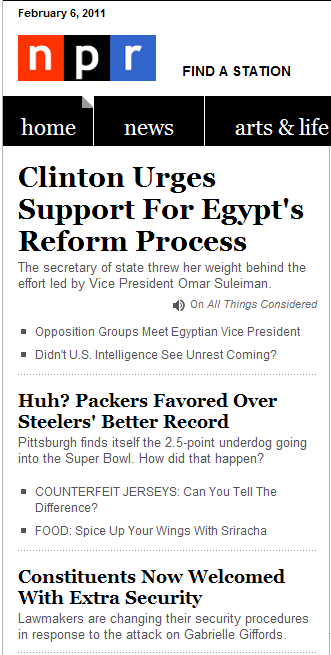
1. NPR – The decks that the public radio broadcaster runs on its front page give readers a bit more information on what each story is about, so they can quickly scan and get the gist of what’s happening, even if they don’t click through to read the whole piece.
2. New York Times – Decks on the Technology page of the paper’s website add details to the headline, but also repeat keywords, good for SEO purposes. They also vary in length depending on the column size, but as these examples show, generally run from 16 to 22 words long and could be one sentence or two.

3. SecondAct.com – This front page of SecondAct.com, a spin off of Entrepreneur Magazinefor people over 40, includes three posts I wrote for the site, each with headlines and decks that came from me: Launching Your Green Job Search, Herschel Walker: From Football to MMA, and Hot Topics: January Jobs, Boomer Headlines, Farrah Fawcett’s Swimsuit. Each one serves a slightly different purpose. The deck on “Green Job Search” lets readers know it’s an author interview. The “Herschel Walker” deck explains what “MMA” stands for. The deck on “Hot Topics,” which is the site’s weekly news roundup, goes into more detail on the top news story, which in this case was the January unemployment numbers.

4. GettheInsideEdge.com – Here’s what heads and decks look like on Inside Edge, the website for CFOs that I work on as a contract editor. One glance at the decks on these stories and you can tell the site’s aimed at mid-sized companies (actually, looking at these all together, we may have used the phrase “mid-sized” a little too often). But since that focus sets the site apart from other websites covering finance, it’s something we want to hammer home every chance we get, including in headlines and decks.

Now that you’ve seen some examples, what are the keys to writing good decks?
- Summarize what a story is about.
- Indicate the type of story a reader will see: a Q&A, review, analysis, etc.
- Spell out acronyms or abbreviations.
- Provide additional detail.
- Be concise.
- Use active language.
- Use colorful verbs.
- Match a story’s voice or tone.
- Foreshadow details in the story without giving away any surprises you’ve saved for the ending.
- Incorporate SEO as needed.
Have your own secrets for writing good decks? Please share by leaving a comment.
Subscribe to:
Posts (Atom)
-
Approximate to Lisinopril 5mg Equivalent to Lisinopril 10mg Approximate to Lisinopril 20mg Approximate to Lisinopril 40mg Approximate to L...
-
డయాబెటిస్ స్వీయ-నిర్వహణ కు ముఖ్యమైన అడ్డంకులు 1) డయాబెటిస్ గురించి పరిజ్ఞానం మరియు అవగాహన లేకపోవడం 2) ఒక నిర్దిష...
-
 Thoracolumbar Junction or Superior Cluneal Nerve Entrapment Syndrome A Hidden Source of Low Back & Pelvic Pain By Marc ...